Live
Open live site ↗Tenlord
Full-stack|PropTech / landlord compliance
TLDR
UK landlord SaaS for properties, compliance documents, reminders, and billing. Next.js clients, ASP.NET API on a VPS, serverless functions for async work, Postgres, payment provider, message bus.
Context. Landlords need a reliable place to track legal deadlines, documents, tenants, and payments, including billing edge cases and reminder schedules.
 Next.jsASP.NET CorePostgresEF Coreserverless functionsmessage buspayment providerobject storage
 DockerAnalyticsFeature flagsMonitoringObservability
Architecture
System diagram
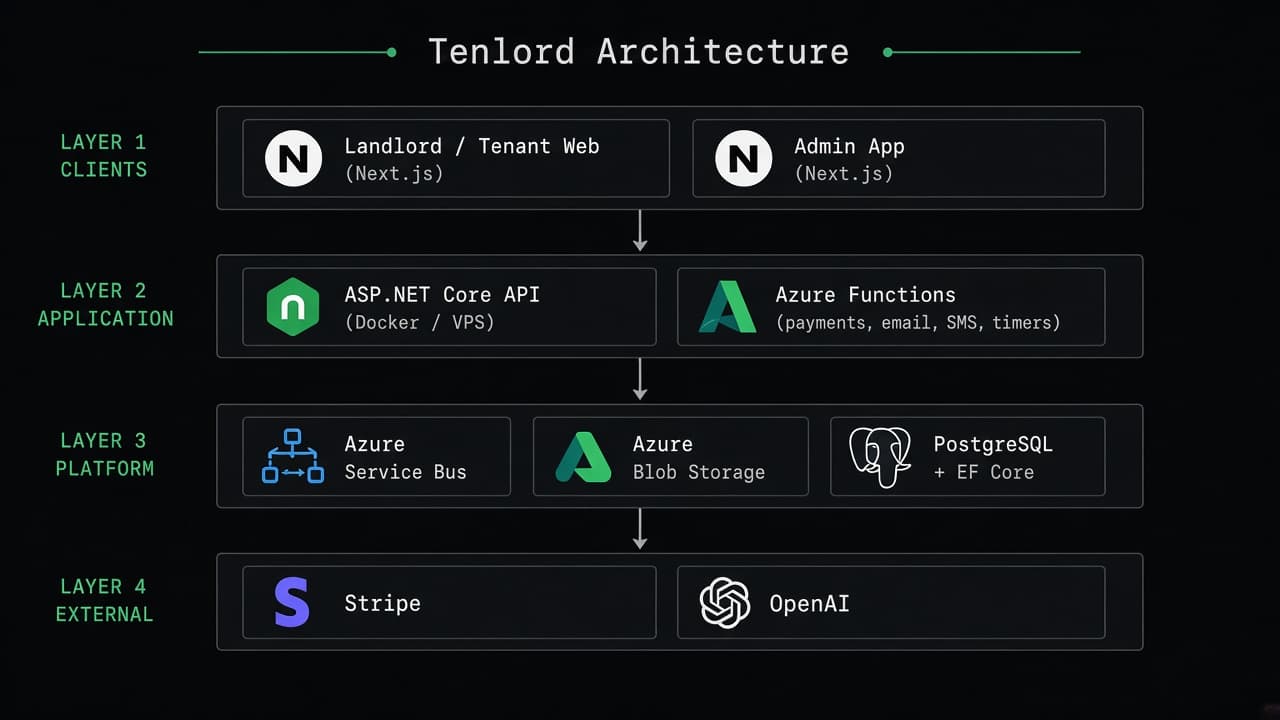
Component map
As deployed
Clients
Landlord / tenant web
Next.js 16
Admin app
Next.js
Application
Tenlord API
ASP.NET Core on Docker / VPS
serverless functions
Payments, email, SMS, timers
Platform
message bus
notifications topic
object storage
Documents and media
PostgreSQL
EF Core
External
payment provider
Subscriptions
LLM provider
Compliance insights
What shipped
- Clean Architecture with Domain, Infrastructure, Shared, API, and Functions projects
- Vertical-slice handlers under api/v1 instead of a thick Application layer
- Landlord-scoped data model: Property to Unit to Occupant / Tenant
- Payment provider freemium plans with idempotent webhook processing
- Email, SMS, and payment side effects moved onto message bus consumers
- Product analytics and feature flags for gradual rollout and behaviour insight
- Monitoring and observability across API, workers, and dependency health
Backend
- REST under api/v1 for auth, properties, units, documents, maintenance, messaging, dashboard, and admin
- JWT roles plus per-handler plan checks for freemium limits
- EF Core and Postgres for subscriptions, compliance cache, audit, and payment event dedupe
- IMemCache today, with a clear path to Redis if the API scales out
- LLM provider compliance analysis cached in the database to avoid repeat spend
- Structured logs, metrics, and traces for latency, failure modes, and queue lag
Request and event flow
- 01Landlord starts payment checkout from the API
- 02Payment provider posts to the payment webhook endpoint
- 03checkout.session.completed is published to the message bus
- 04PaymentProcessor Function applies the subscription in a transaction
- 05Confirmation email is queued and sent by a notification Function
- 06Timers send daily compliance reminders and verification nudges
API domains
- Auth and users
- Properties and units
- Documents and compliance
- Maintenance
- Messaging
- Payments and payment provider webhooks
- Admin
Key decisions
- Next.js for client shells with clear data boundaries; compliance and domain reads stay on the ASP.NET API.
- Keep the HTTP path on the API. Put mail, SMS, and payment apply on serverless functions so retries sit with Azure.
- Verify payment provider webhooks, then process checkout completion through the message bus with processed payment event records for idempotency.
- Cache LLM provider compliance results in Postgres by property and input fingerprint to avoid repeat model calls.
- Use IMemCache for hot landlord reads now, with a clear swap path to Redis if the API scales beyond one instance.
- Run the API in Docker on a VPS for cost control. Keep serverless functions on Azure Flex Consumption for async and scheduled work.
- Ship analytics and feature flags early so product changes can be measured and rolled out safely.
- Treat monitoring and observability as part of the platform: health checks, metrics, and traces on API and workers.